 WOWBatangas.com Your Source of Great News and Stories from the Province of Batangas, Philippines


Celebration of Padre Garcia’s Kabakahan Festival 2020 on December 1, 2020.


On “Black Saturday,” preparations are made for the late-night Easter vigil at church. There, the Gloria is sung, and some call it “Glorious Saturday.” In some places, an effigy of Judas is hung and burned up, though sometimes, he is blown to pieces by firecrackers. At midnight, the fasting and mourning ends because it is finally the day on which Christ arose from the grave in victory.
A 4am on Easter Morning, a ceremony commemorates the meeting of Mary and Jesus after the Resurrection. The black-veiled image of Mary is unveiled by one or more people dressed up like angels, and sometimes, the veil is tied to balloons or a dove to be carried away in the air. The image of Christ also is unveiled, and flowers and confetti fall down on the statues of both Mary and Jesus. Bells ring and fireworks explode in the sky. Legend has it, however, that if the veil is removed only with difficulty, bad luck will accompany the year to come.


Dr. José Rizal, the Philippines’ National Hero, is celebrated on his namesake day every 30 December.
The first president of the Philippines, Emilio Aguinaldo, commemorated the first Rizal Day in 1898. Born on 19 June 1861, José Rizal is considered as the one of the greatest heroes in Philippine history, and is credited as starting the Philippine revolution against the Spanish colonisers.
Rizal, a man of many talents, was notably a ophthalmologist and a novelist. His two novels, “Noli me Tangere” (“Touch me not”) and the sequel “El filibusterismo” (“The Filibustering” or “Reign of Greed”) exposed the injustices brought on by the Spanish colonisers in the Philippines. Many scholars and historians would agree that it was the ideas in these two books that influenced the already discontented Filipinos to act against the Spanish.
Subsequently, he was arrested for treason and for being associated with the revolutionary forces (although he did not take part in any type of warfare). He was convicted on the grounds of rebellion, sedition and conspiring against the government, and was sentenced to execution by a firing squad on 30 December 30 1896. His death was the last straw for the Filipinos and thus began the end for the Spanish colonisers.
Official events centre around the main Rizal shrine, in Rizal Park in Manila. Flags are at half-mast and the President of the Philippines lays a wreath at Rizal’s shrine, as a symbol of the nation’s gratitude and reverence. As it is a public holiday, most people take the day off from work and spend time with family and friends.

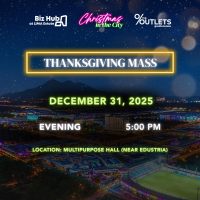


 Thrill at the Field of Rides
 Hunt for the perfect gifts
 Watch a dazzling fireworks display
 Feast with loved ones at your favorite resto
 Pose and take photos with our glowing displays


Join the 7th Bisikleta Iglesia: Dasal at Padyak Para sa Pagbangon ng Batangas this coming April 04, 2020, 5 am at LimaPark Hotel as the assembly point and will proceed to The Outlets at 6:30 am.
Bisikleta Iglesia will be visiting the following churches including Sto. Niño Parish Church, Marawoy; Our Lady of Lourdes Chapel, Bulacnin; Our Lady of Fatima Chapel, Balete; Sacred Heart of Jesus Chapel, Marian Orchard, Balete; Nuestra Señora dela Paz y Buen Viaje Parish Church, Balete; Immaculate Heart of Mary Chapel, Marian Orchard, Balete and Metropolitan Cathedral of San Sebastian, Lipa.
Part of the proceeds would go to the areas affected by the Taal Eruption.
Free Commemorative shirt Bisikleta Iglesia Jersey for first 100 to register. Lots of raffle prizes await joiners! Registration fee is Php 499 nett inclusive of breakfast and lunch.


Happy 52nd Founding Anniversary Laurel, Batangas!
Maligayang ikatlong taong pagdiriwang ng Tilapia Festival!
Tema : Sari-saring pagsubok ay ating lagpasan. Ngiti lang kabayan. Magtutulungan at muling magkakasiyahan, Laurel Minamahal kong bayan.
Abangang ang kanilang Online Live Celebration ngayong darating na ika-21 ng Hunyo, 2021 | 7PM sa Tilapia Festival Official Facebook Page at sa WOWBatangas.

San Juan, Batangas Founding Anniversary December 12, 2020

The EDSA People Power Revolution Anniversary occurs every 25 February in the Philippines. It commemorates the peaceful demonstrations that occurred in 1986 and led to the overthrow of the corrupt rule of President Ferdinand Marcos.


Independence Day in the Philippines is held every 12 June and commemorates the Philippines’ declaration of independence from Spanish colonial rule.
The original Independence Day was held in 1898 in present day Kawit, Cavite where General Emilio Aguinaldo read out the The Act of the Declaration of Independence. Whilst this was an important milestone for Filipinos, the Spanish government did not recognise their independence.
They then went on to give the Philippines to the United States after the Spanish-American war as part of the peace treaty. After a war and the Philippines’ own treaty with the United States, independence was granted to the Philippines on 4 July 1946, coinciding with the American Independence Day.
4 July was celebrated as Independence Day until 1964. After mounting pressure from the community, the government declared that 12 June would be The Philippines’ Independence Day and a national holiday. 4 July in the Philippines would then become the Philippines’ Republic Day.
A parade in Manila marks the official celebrations, attended by the President and government officials. The parade showcases the Philippines’ armed forces as well as some local organisations and the different ethnic groups of the Philippines. Firework displays are also held, particularly in Manila.


Online celebration of 172nd Founding Anniversary of San Juan, Batangas and Lambayok Festival on December 12, 2020.




Every 8 December is Immaculate Conception Day in the Philippines, a holiday that is commemorated in many other Roman Catholic-majority countries around the world.
The devout in the Philippines attend special masses on this day in honour of the Virgin Mary and the belief in her having been conceived without sin. The day is also supposed to be a day when Catholics avoid any “unnecessary work”.
The main event on Immaculate Conception in the Philippines is the procession of Marian images from all over the country around the old walled city in Manila. There are 90 or more such images, many of them very ornate and associated with claims of miraculous appearances and healings or the like. This event is often dubbed, “The Grand Marian Procession”.
The carriages that carry the images of Mary, called “carrozas”, are also very ornate and are filled with flowers and lit candles. And a marching band may accompany the images “Marian parade”.
The first of these Immaculate Conception processions took place in 1619, was designed to promote the catechism, and lasted for 15 days. The modern ones are shorter, but have more images and are focused on reverencing the Virgin Mary rather than the catechism as such.


The Philippines celebrates New Year’s Day with a public holiday every 1 January, as does most of the rest of the world. However, the celebrations really begin on New Year’s Eve and reach a high point with the turning of the clock from 11:59pm on 31 December to midnight on 1 January. Somewhat unusually, New Year’s Eve is also an official holiday here.
Fireworks, good food and good company, New Year’s resolutions, and greeting cards are all a part of the celebration in the Philippines. Attending midnight mass on 31 December is a practice of devout Roman Catholics. Firecrackers and loud noises are traditionaloy thought by some to scare off evil spirits, and leaving doors and windows open is supposed to let the good luck come in.
Parents may tell their children to jump as high as they can at midnight to help them grow taller. Others don polka dot clothes to make the new year more prosperous. And some put 12 fruits on display to symbolise the 12 disciples.


 A view of Taal Volcano from Tagaytay, Batangas as it spew thick clouds of ash on January 13, 2020. Photo by Alecs Ongcal/Rappler[/caption]