 WOWBatangas.com Your Source of Great News and Stories from the Province of Batangas, Philippines

 We can’t wait to see you this October 26, 2024, at Batangas Lakelands!


Independence Day in the Philippines is held every 12 June and commemorates the Philippines’ declaration of independence from Spanish colonial rule.
The original Independence Day was held in 1898 in present day Kawit, Cavite where General Emilio Aguinaldo read out the The Act of the Declaration of Independence. Whilst this was an important milestone for Filipinos, the Spanish government did not recognise their independence.
They then went on to give the Philippines to the United States after the Spanish-American war as part of the peace treaty. After a war and the Philippines’ own treaty with the United States, independence was granted to the Philippines on 4 July 1946, coinciding with the American Independence Day.
4 July was celebrated as Independence Day until 1964. After mounting pressure from the community, the government declared that 12 June would be The Philippines’ Independence Day and a national holiday. 4 July in the Philippines would then become the Philippines’ Republic Day.
A parade in Manila marks the official celebrations, attended by the President and government officials. The parade showcases the Philippines’ armed forces as well as some local organisations and the different ethnic groups of the Philippines. Firework displays are also held, particularly in Manila.


The New Year is a celebration of the end and beginning of a year based on the lunar calendar. The holiday celebrates the events of the past year, while ushering in good fortune for the upcoming year. The lunar New Year celebrations in the Philippines are approached with the same exciting outlook as they are in Mainland China.




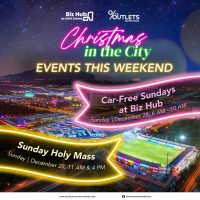

 Join our last Car-Free Sunday of the year at Biz Hub, a perfect way to stay active and enjoy the fresh air.
 Then, gather your loved ones and attend our Sunday Holy Mass as we give thanks for the blessings of this whole year.
 Our extended mall hours still apply this weekend, so you can make the most of your time to dine, shop, and play this holiday season.


Check out the Biggest Travel, Trade, and Lifestyle Expo in Lipa City! 3-industries-in-1-Expo presented by Infinite Productions. This coming May 30-31, 2020 at The Outlets at Lipa.
For more details regarding this EXPO, contact the ff:
0917 533 5035 | 0933 879 3103


 is available from March 25-31, 2024 only. Limapark Hotel is located inside the Lima Estate in Malvar, Batangas.


Calatagan, Batangas Founding Anniversary December 16, 2020


 Be the first to see the exclusive promos and exciting updates from Batangas Lakelands by joining our Viber community!

Good Friday is part of the Christian Easter Week celebrations (also known as ‘Holy Week’). Good Friday is two days before Easter Sunday, which normally coincides with the March Equinox and may also coincide with the Jewish Passover.
Good Friday in the Philippines is a national public holiday commemorating the crucifixion of Jesus Christ. The crucifixion is symbolised by the Cross and, according to the Biblical Gospels, it was by this ancient form of death penalty that Jesus Christ sacrificed himself and died so that he could save humanity from their sins.
Easter is a solemn holiday season and many Filipinos abstain from activities they may deem as ‘worldly’ (e.g. drinking alcohol). On Good Friday, many choose to abstain from eating meat and often pray and fast as part of their religious traditions.
Masses are held in the early afternoon to commemorate and reflect on Jesus’ crucifixion. According to Christian scriptures, Jesus died on the cross at 3pm, so it is at this time in the mass that people become silent and meditate on Jesus’ sacrificial death.
Catholic Filipinos observe the Stations of the Cross as part of the Good Friday mass. These ‘stations’ are often paintings or sculptures that depict specific moments of Jesus on his way to be crucified. They are also often re-enacted by actors as part of an Easter procession. In the Philippines in particular, some people even go so far as to crucify themselves on a wooden cross to symbolise their devotion, as part of their penance or vow.


The Cyber Exclusive Sale is on! IHG One Rewards members save 25%. Everyone else can save 20%. Book by 4 December 2025, for stays between 25 November 2025 – 31 March 2026.
Book now: https://www.ihg.com/…/gb/en/deals/hotel-offers/cybersale
#HolidayInnandSuitesBatangasLimapark #IHGOneRewards #ExperienceIHG #anIHGHotel